CONFIDENCE
Courses run May through September. Each class runs 5 days, Monday through Friday.
Class sizes are held to 3-4 people so each person receives plenty of hands on experience and personal attention.
The best part of training with other similarly motivated pilots is the feedback and experience that you can use to benefit your own practice. It also eliminates the "rookie" or subordinate feeling felt in a club of experienced flyers or when dependent upon recreational club instructors and their schedules.
Students train at the flight school's private flying site utilizing our One Week To Solo syllabus developed over decades of professional instruction.
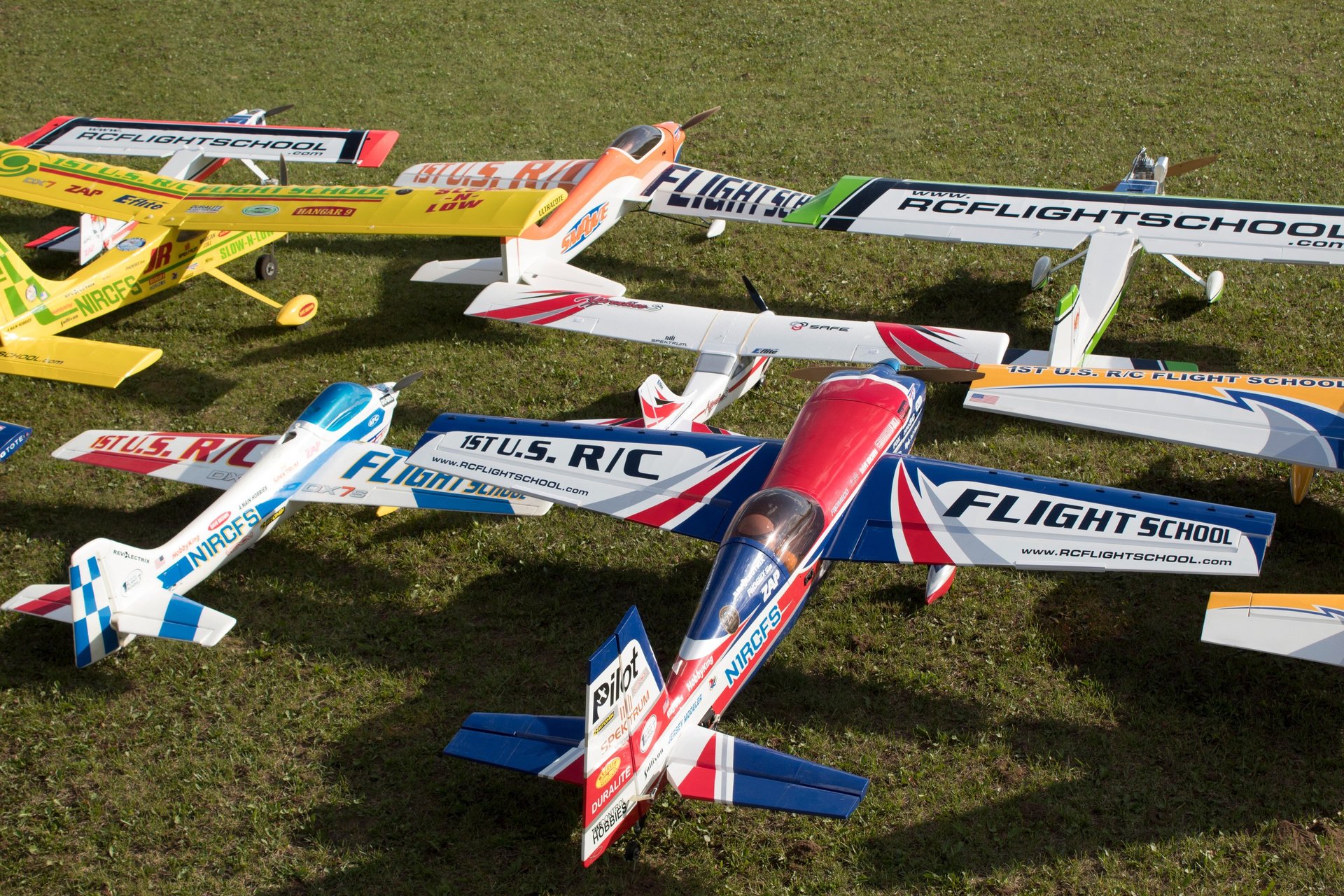
The planes and all equipment needed during the course are provided by 1st RC Flight School.
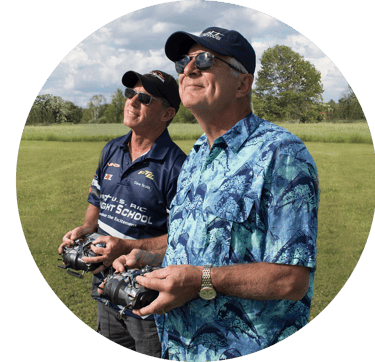
We utilize the "buddy" system: You control the airplane with a transmitter wirelessly connected to the instructor's transmitter. The instructor can instantly take back control (but only when absolutely necessary) so that you can focus on learning with less anxiety until your skills have increased. You'll also have much more time to think through and recover from your own mistakes, thus learn from them and build confidence in your control skills to return home with.
You will be exposed to wind and thus build confidence to fly in wind when you get back home. FYI: The principle effect of wind is NOT that it causes a lot of deviations. Rather, it tends to exaggerate mistakes and weaknesses in peoples' flying that they can otherwise get away with in calmer conditions — further emphasizing the importance of proper training.
SOLO COURSE DETAILS
NO TRIAL-AND-ERROR HERE...
Training will begin Monday at 9:00 A.M. with Ground School located at the Shawano Municipal Airport conference room (Google map), where we will discuss:
1. Previous experience.
2. Your goals in RC.
3. Uses of transmitter controls and effects.
4. Overview of the 5-days of instruction.
5. The DAS System key elements to acceler-ated Solo.
After an approximate 2-hour Ground School we will relocate to our private flying site where we will spend the rest of the week flight training free of distractions.
Instruction will begin with Dave Scott demonstrating procedures designed to bypass common errors and enhance your practice effectiveness. (Consider that when a pilot applies his or her control inputs correctly to begin with, the need for additional corrections is less likely, leaving more time to focus on learning and thinking ahead to what you'll do next.)
That's what the DAS System is all about: Taking the techniques attributable to the best pilots who fly with the greatest ease—traditionally learned over long periods of time—and systematically applying them to the student pilot from day one. Why go to school?
PREPARATION...
PROFESSIONALISM...
PROVEN RESULTS...
Confidence hinges on advancement, but you can't gauge success without first defining it. So each flight lesson is explained in terms of what we're going to do, how we're going to do it, why it is done this way, i.e., where it will fit in the scheme of your solo and better flying in the future. The way the training is structured, achieving good landings and your first Solo won't seem like hurdles, but more the result of everything that you had been practicing leading up to them. Once Solo is achieved, we will then break down your flight in more detail in order to refine it.
With the experience of training thousands of pilots to draw from, Dave Scott will be able to quickly formulate strategies to overcome any trouble spots that you may experience along the way with minimal interruption in your overall progress and confidence. No other source can provide you this level of experience and personal attention. Students say that one of the most important features of retaining the services of the flight school's professional flight instructor is the absence of feeling bothersome or imposing when asking questions. Not only will questions be encouraged, each answer will be supported with a reason WHY.
Notes for Enrollees: We strongly suggest that you acquire the ONE WEEK TO SOLO manual prior to the course to familiarize yourself with the terms and techniques that will be used in your training. If you have a laptop with RealFlight installed, we highly recommend that you bring it to practice on between sessions.
If you can bring your simulator, doing so will be a big help to reinforce the lessons taught earlier in the day and thus ensure greater productivity moving forward.
We do not take a lunch break. If you bring snacks, we recommend that you keep them light to avoid the fatigue that typically follows a normal size lunch. Cold drinks are a must in the summer time. The flight school does not provide a cooler at the field because students usually prefer to arrange their own coolers the night or morning before training.
Weather: While no one can control the weather, efforts will be made to conduct double sessions to build up flying time if rain is forecasted, or to make up for rain delays.
Bring enough clothing for a variety of weather. Average May temps: 50 degrees (morning) 65 degrees (afternoon), June: 50-75, July: 60-85, August: 60-80, September: 50-70. A hat is recommended as well as insect repellent. Sunscreen and sunglasses are necessities!
Of course the biggest advantage taking the training course is the concentrated day after day practice.
While the flight school's primary emphasis is on flight instruction, there are many opportunities to discuss RC equipment operations to ensure that you have the practical knowhow to go along with your new flying skills. You'll also be able to observe what brands of equipment hold up best under the constant use and abuse of daily training, and thus can be expected to provide outstanding performance and reliability for the individual flier.
To understand what the school's equipment is subjected to, here are a few 1st RC Flight School stats:
Number of pilots trained:..Over 2300
Number of flights:...........Over 42,000
Actual flight time:............Over 12,000 hrs
Number of landings:.......Over 80,000
Age range of students: from 7 to 87; average age: 55
The combination of concentrated training, a proven system, personal attention, constructive exchanges between classmates, and reliable equipment all add up to bring out your best flying and enable you to start fully enjoying the many rewards of RC flying!
"The course totally exceeded expectations, and I had high expectations. I now have the confidence that I am totally in control of my plane. The DAS system can't be that simple, and yet it is!!! Feel free to have anyone who wants confirmation of your courses worth to email me. I will tell them that it is the best $ I have ever spent in the hobby."
Steve Storman. Harrington Park, NJ
"I cannot express how much you've helped me gain confidence. That first day when you had me fly in 20 mph winds, I would not have believed it unless I had tried it myself! Your training has helped me to be better prepared to fly successfully on my home field."
Michael Anthony. Napperville, IL
"Your approach of treating both flight preparation and the actual flying as though it were full scale is absolutely on target for maximal learning and fun with minimal headaches. I only wish I'd come to the School BEFORE making all the ridiculous mistakes!"
Ken Moore. Las Vegas, NV
"My flights keep getting better each time out since the week at your school. I am increasingly more confident and more relaxed flying. The techniques you’ve taught me are just what I needed to become an independent flyer. Thanks again for being such a great instructor."
Tom Nelson. Streamwood, IL

314 W. Pine St.
Shawano, WI 54166


HOME
Info
About the Instructor
Mission Statement
Field Map
Follow Us on
rc@flightschool.com
715-853-1003