
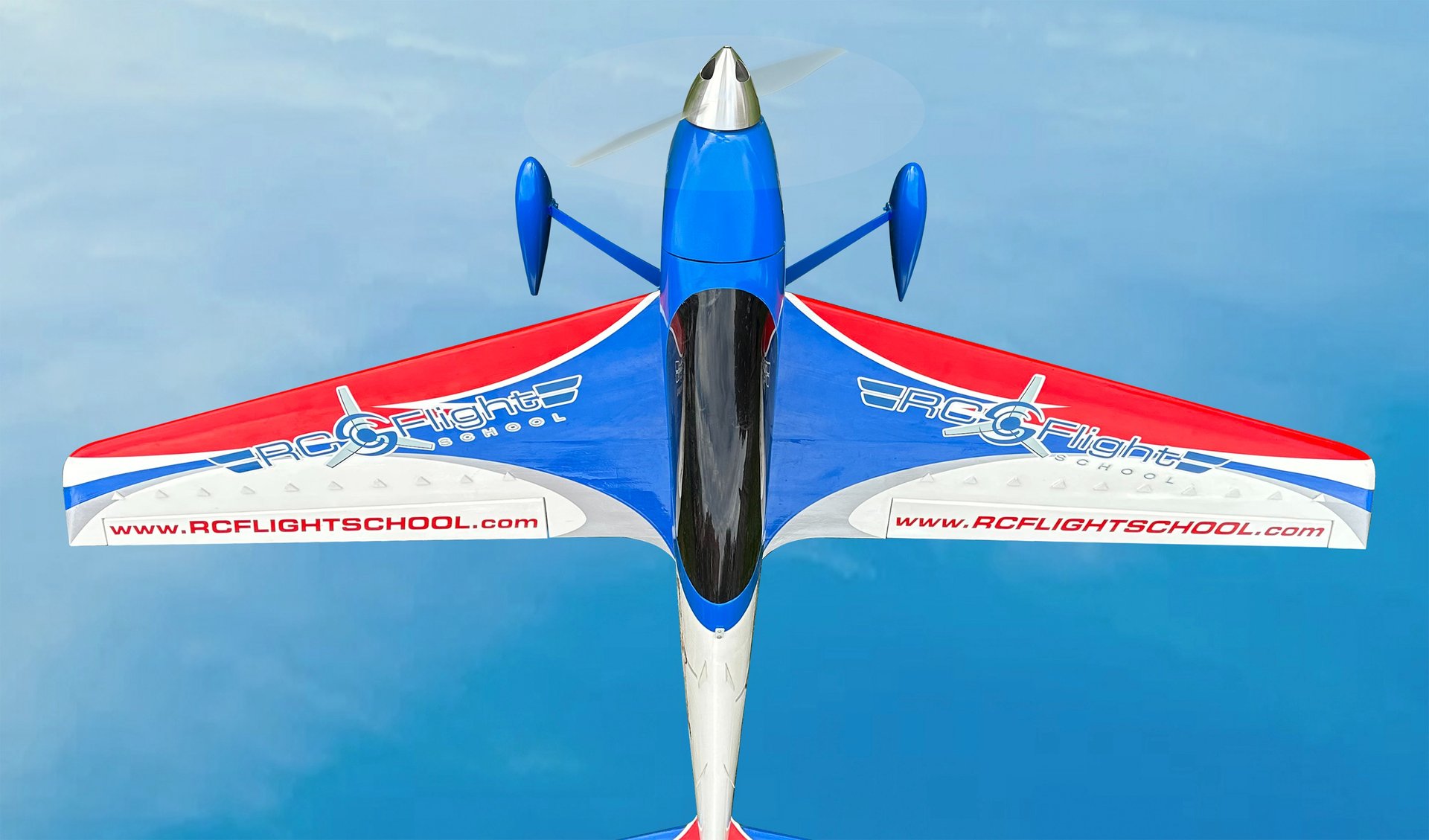
DISCOVER THE EXCITEMENT
AEROBATIC COURSE DESCRIPTIONS
Note: While 4 example courses are listed here, all aerobatic courses are custom tailored to the skill level and goals of each pilot attending.
Refresher/Phase I: Fundamentals will be reinforced, yet in the interest of maximizing total learning, we will practice as much of the Sport Aerobatics program as is practical in order to, among other things, make general flying, especially landings, seem easier and happening slower. Sample of Contents
Phase I. Sport (Basic) Aerobatics: Basic looping and rolling maneuvers will be first practiced individually, and then assembled into a continuous aerobatic sequence of one maneuver after another. Progressive variations will be added to the maneuvers as we go. Sample of Contents
Phase II. Precision (Intermediate) Aerobatics: Additional precision is applied to all Sport Aerobatic maneuvers. New maneuvers are added, with the emphasis throughout the week on anticipating the proper uses of Rudder to prevail over both wind and engine torque. The result is that pilots are able to maintain an uninterrupted sequence of maneuvers in any condition and enjoy the hightened satisfaction of a flight very well done. Sample of Contents
Phase III. Advanced Aerobatics: Inverted flight, knife-edge, slow rolls, and using rudder to put the finishing touches on all maneuvers. Snap rolls, spins, and vertical maneuvers with options on the up and downlines. 3D Lomcevak, rolling turns, and much much more. Sample of Contents
AEROBATIC COURSES
Courses run May through September, with each class running Monday-through-Thursday. (Aerobatic courses are 4 days because aerobatics are more quickly learned than learning to fly solo.) Aerobatic classes begin Monday 9:00 AM at the flight school's training site (map). Class sizes are held to 2-3 people so each person receives plenty of hands on experience and personal attention. The planes and all equipment needed during the course are provided by 1st RC Flight School.
Aerobatic lessons are taught using the same DAS System crawl-walk-run format used in the Solo Course to produce maximum results in the least amount of time: A. You will be systematically exposed to the techniques shared by the best aerobatic pilots—traditionally learned over long periods of time—from the start. B. Each maneuver will be broken down into sequential steps and first practiced in its rudimentary form to facilitate ease, consistency, and your ability to think ahead of the airplane. C. Once each maneuver has become routine, we will build in the natural progression of refinements and/or add new maneuvers.
With the experience of training hundreds of aerobatic pilots to draw from, Dave Scott will be able to pinpoint the cause and advise the solution to overcome any trouble spot you may experience along the way, with minimal interruption in your overall progress and confidence.
NOTICE: To progress and succeed in our Aerobatic programs, you need not have practiced extensively beyond Solo. You will find that executing the maneuvers is not hard when things are done in their proper sequence. It is the process of perfecting them that takes practice along with an organized training approach and a foundation built on good habits.
Click here first if you are interested in attending an Aerobatics course, but did not learn to fly solo at 1st RC Flight School.
TYPICAL 4-DAY SCHEDULE
Day 1. 9:00 A.M. Ground School start at the flying field. 4-day agenda discussions and setting preliminary goals.
Flight evaluations: Reinforcing good fundamentals and correcting any bad-habits.
Establishing a foundation of parallel positioning and positive control feel.
Practice looping and rolling maneuvers, and multiple maneuver combinations.
Session review and planning tomorrow's itinerary. Finish approx. 2:00-3:00
Day 2. 9:00 A.M. Ground School start at the flying field. Review of the previous day and current objectives. Assembling maneuvers into a continuous aerobatic sequence. Introducing new maneuvers.
Routine practice to develop automatic inputs, timing, and confidence.
Session review and planning tomorrow's itinerary. Finish approx. 2:00-3:00
Day 3. 9:00 A.M. Ground School start at the flying field. Review of the previous day and current objectives.
Solo Aerobatics: Less walking you through, and more coaching personal key points. Focusing on areas needing extra work. Adding applicable refinements.
Session review and planning tomorrow's itinerary. Finish approx. 2:00-3:00
Day 4. 9:00 A.M. Ground School start at the flying field. Review of the previous day and current objectives.
More Aerobatics practice. Adding variations to certain maneuvers.
Optional: Experience flying a more advanced model type.
Session review and planning home flying objectives. Finish approx. 2:00
1st RC Flight School has numerous types of electric and gas aircraft to suit every skill level. You are welcome to bring your own airplane, but it is not crucial that you do. Good aerobatic flying is achieved through good planning and an emphasis on controlling the plane instead of reacting to it. While one plane might require more or less elevator than another, the steps that make up the maneuver remain the same. Therefore, whether you fly our planes or your own, the instruction will be equally effective (assuming that when you return home the first thing you do is adjust the controls to match your skill/comfort level and the type of maneuvers you perform).
If you bring your model and use a radio other than Spektrum, if possible, we ask that you bring a 2nd transmitter setup as a trainer box. This will enable us to train without reservation or fear of crashing until skills are learned. More importantly, it allows a seamless transfer of control back to the instructor for demonstration purposes.
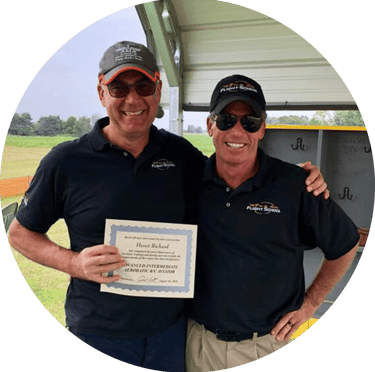

Notes for Enrollees: We strongly suggest that you acquire the appropriate training manual(s) for your skill level prior to the course to familiarize yourself with the terms and techniques that will be used in your training. Manuals Page
If you can bring your simulator, doing so will be a big help to reinforce the lessons taught earlier in the day and thus ensure greater productivity moving forward.
We do not take a lunch break. If you bring snacks, we recommend that you keep them light to avoid the fatigue that typically follows a normal size lunch. Cold drinks are a must in the summer time. The flight school does not provide a cooler at the field because students usually prefer to arrange their own coolers the night or morning before training.
Weather: While no one can control the weather, efforts will be made to conduct double sessions to build up flying time if rain is forecasted, or to make up for rain delays.
Bring enough clothing for a variety of weather. Average May temps: 50 degrees (morning) 65 degrees (afternoon), June: 50-75, July: 60-85, August: 60-80, September: 50-70. A hat is recommended as well as insect repellent. Sunscreen and sunglasses are necessities!
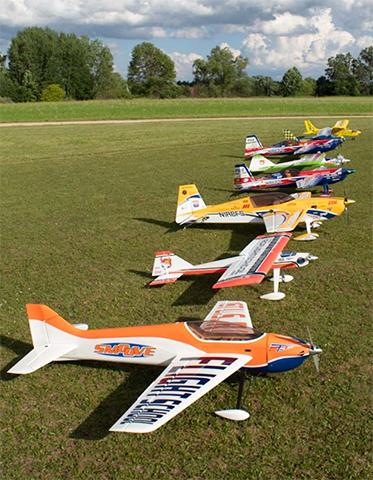
Notice to aerobatic students bringing your own planes
The right training can make an incredible difference in your flying. You can be certain that after investing in a week of aerobatic training at 1st RC Flight School your confidence and skill will be elevated to a point that traditionally would have taken months or years (if ever) to acquire on your own!
"Your instructions, coaching, patience and willingness to adapt the curriculum and the airframe to better fit my needs was an incredible experience for me. I was blown away at all we were able to accomplish in such a short amount of time."
Tim Black. Washington, DC
"The school was without doubt the finest training short course I've ever taken. Those 4 days rejuvenated my interest and desire to improve. You are an incredible teacher, who mixes the right amount of enthusiasm with an enormous knowledge of flight."
Herb Carpenter. Plattsburg, NY
"I want to thank you for a great week at your school. I had been afraid to fly my Kaos, but the first time I flew it back at my home field I had a blast with it. My confidence is at a new high. Flying is so much fun now. Your carwl-walk-run training really works!!!"
Joel Smith. North Grafton, MA
"What a difference a little flight instruction makes!! Even my landings were better!! It is such a pleasure to fly the various maneuvers with competence. The school is the best investment I've ever made!"
Marvin Jones. Prescott, AZ

314 W. Pine St.
Shawano, WI 54166


HOME
Info
About the Instructor
Mission Statement
Field Map
Follow Us on
rc@flightschool.com
715-853-1003